
.:[Double Click To][Close]:.
Showing posts with label Science. Show all posts

World's First Scar-free Appendectomy

image showing appendectomy through man mouth

The world's first scar-free appendectomy has been successfully performed at University of San Diego Medical Centre, USA. Jeff Scholtz, a former U.S. marine, has recently secured his place in medical history, becoming the first patient in the world who had his appendix through mouth removed.

The operation, which is a major advance in the quest for scar-free surgery, was performed by doctors in San Diego, California, who used a flexible tube to thread miniature surgical instruments down the 42-year-old's throat to his stomach.

A tiny incision was then made in the stomach wall to get at the appendix - a small worm-like pouch attached to the large bowel.

The inflamed appendix was cut away, bagged and pulled back into the stomach - and out of the mouth.
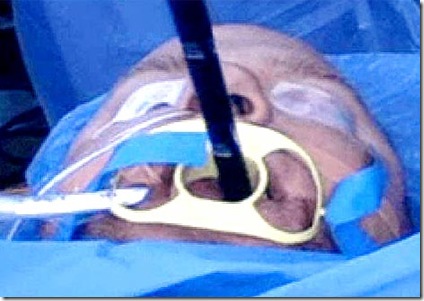
Jeff Scholz  Appendix removal surgery

Source: DM

Flesh-eating Caecilian

flesh eating amphibian caecilians

The Caecilian [wiki] is an amphibian that superficially resemble earthworms or snakes. But because it mostly lives hidden in the ground, it has become the least explored order of amphibians, and widely unknown. Not until recent, scientists discovered that it has a bizarre parental behaviour--the caecilian mother allows her young to peel off and eat her skin. It has been filmed on camera by building a set which resembled the creature's living environment for the broadcasting network's  Life In Cold Blood series.

One of the strangest meal-times in the animal kingdom has been caught on film by a BBC crew.

The female caecilian's skin becomes thicker and more nutrient-rich when she bears offspring.

And the young have specialised teeth for tearing and removing it.

The crew was able to catch this behaviour

It took several attempts to capture the footage; the caecilian babies would only eat their mother's skin for about 10 minutes, once every three days, and often at night.

Source: BBC. Click here to watch the footage.

Mercury Spider Is a Spidery Crater on Mercury

mercury spider picture

Mercury Spider (picture above, credit: NASA) is not any known spider species on the Earth, but a unique geologic formation called the Spider sits at the center of the Caloris Basin[wiki] on Mercury. It was just revealed to the world in one of more than 1200 pictures taken from from the unseen side of Mercury by NASA's MESSENGER probe during a recent flyby on January 14. The spidery shape is "unlike anything we've seen anywhere in the solar system," said mission chief scientist Sean Solomon of the Carnegie Institution of Washington. The image showing what looks like a large crater with [25 miles wide] faint lines radiating out from it demonstrates that Mercury had volcanic eruptions millions of years ago and is a shrinking, aging planet. Link


Naked Mole Rats Hold Clues To Human Pain

Naked mole rats picture

Naked mole rat (Heterocephalus glaber), also known as the sand puppy, or desert mole rat, may help scientists to unlock the secrets of pain reception in humans, because they appears to lack a neurotransmitter that is crucial to the sensation of certain types of pain, a recent research revealed that.

The research was published in the journal PLoS Biology on January 29. It was under the lead of Thomas Park, a professor of of biological sciences at the University of Illinois at Chicago. The study revealed the curious adaptations of naked mole rats that altered the way they experience pain.

In this study, the investigators stimulated the naked mole rats with those substances such as acid and capsaicin, but the rats completely didn't care the pain.

They found that the phenomenon may be linked to substance P, a neurotransmitter which is a common component of pain responses in nearly every mammal, including humans.  #Link

Men Born Short Increased Risk of Attempting Suicide

newly born baby

A new study done by scientists from the Karolinska Institute in Stockholm found that male babies who are born short in height, are more prone to commit suicide than those born at normal height. Excerpts from Earthtimes.Org

The Swedish study involved 713,000 people of whom 320,000 were males. The researchers tracked the date of birth, attempted suicide if any, death or emigration from the country till the year 1999. The researchers used national registries in order to track down these men.

Surprisingly researchers found that shorter babies with a height of 47 cm or less were more likely to attempt suicide as adults. This statistic was independent of what height they eventually reached as adults. Furthermore men who were short of height as adults were also 56 percent more likely than their taller counterparts to attempt suicide.

Lead researcher Dr Ellenor Mittendorfer-Rutz opined that low levels of serotonin in the brain was the key to this behavior.

New Palm Tree Species Found in Madagascar

 picture of new palm tree species found in madascagr

Palm Tree Tahina spectabilis (picture credit: AP via BBC)

A new species of giant self-destructing palm was found  in Madagascar by botanists from Kew Gardens of London. Scientists believe it is possible that the palm has quietly gone through a remarkable evolution since Madagascar split with India some 80m years ago.

The tree, which only exists in the remote north-west of the island country in Indian Ocean, is 20m (60ft) high with leaves 5m (16ft) long, the tallest tree of its type in the country, and has a lifespan of around 100 years.

In the living memory, the tree was never seen blossoming not until 2007. But botanist only found that the tree expends so much energy on flowering that it eventually collapses and dies.

The palm has been named Tahina spectabilis, which is Malagasy for "blessed" or "to be protected". It is also one of the given names of Anne-Tahina Metz, the daughter of Xavier Metz, a Frenchman who manages a cashew plantation in remote northwestern Madagascar and discovers the palm in 2006. Source: BBC