.:[Double Click To][Close]:.
Showing posts with label Reflections and Ruminations. Show all posts

"Open the door and see all the people"

It is one of those days when there are many things to write about, but I have little time or desire to write about any of those things. Besides, there is nothing about which I want to comment that can't wait until a better time and day. I was speaking to the rector of the Cathedral at which I serve yesterday just prior to our midday Mass. We were discussing the many things going on and how they affect both the Church in general and our parish community in particular. It was a nice conversation because it wasn't world-weary or cynical in any way. It also wasn't about money, but a productive pastoral discussion about the people we both serve, whom we both love.

Towards the end of our conversation, he was telling me some advice he had very recently given to a few people independently of each other: "The best thing you can do for your life, for your faith, for your family is come to Mass every Sunday, find a pew, and join in. That is what will change things." I agree with this very wholeheartedly! Occam's razor is best applied to advice and wisdom, the simpler, the better. I mean, the parish is where church happens for just about every, single member. It doesn't happen on television, even on EWTN, in popular Catholic magazines, or via media of any kind, including blogs! Without a doubt, what I like best about our downtown Cathedral is that every Mass is like the eschatological banquet described by Jesus in Luke (14:15-24).

The Cathedral of the Madeleine

Trinity Sunday was the perfect day to point this out. After all, just as God, who is Father, Son, and Holy Spirit, is a communion of persons, the Church, too, is a communion of persons, albeit of human persons (often all too human, to cite Nietzsche), instead of divine persons. In and through the Eucharist we celebrate together (we call it the liturgy, meaning our common work), God is at work drawing us into the very life of the Most Holy Trinity. But what keeps this from being merely a nice, abstract idea is the concrete community to which I belong. Like the disciples at Jesus' Ascension, my gaze is levelled, my attention brought back to reality, which is my path to destiny. This is just as true of priests, deacons, and religious as it is anyone in the church. Plus, this has been true of the Church of Jesus Christ from the beginning: "And they devoted themselves to the apostles' teaching and the fellowship, to the breaking of bread and the prayers" (Acts 2:42- ESV).

As we approach the great solemnity of Corpus Christi, let us be mindful that the only empirical evidence that the bread and wine really and truly become Jesus Christ, body, blood, soul, and divinity, is the witness given by those of us who partake of it.

Witnessing what it means to be a father

Because I want to be free from as many commitments as possible tomorrow, I wanted to post something for Father's Day a little early. Going back to my days as an accomplished high school extemporaneous speaker under the tutelage now U.S. Representative- Rob Bishop, I want to briefly write about three things: First of all, I want to wish a happy Father's Day to two parishioners and friends who are truly remarkable dads, Paul and Joseph. Paul is the father of two beautiful daughters. He was unexpectedly left as a single parent when his wife tragically died in November 2010. Joseph is the single father of 5 children after being divorced. Both of these men show me what it means to be utterly selfless, especially when I might be getting a little full of myself, in their service to their children. As fathers, both of these men really show anyone who cares to pay attention what it means to be a dad. The power of their witness lies in the quiet way they live deeply Christian lives on behalf of their children.

The second thing is that yesterday was my Dad's 73rd birthday. As my readers know, he passed in January. Tomorrow will be my first Father's Day ever without him in the world. It makes me feel kind of empty. His headstone is being installed today, in the space between his birthday and Father's Day. It brings home to me, yet again, how blessed I was to have a Dad, a man of few words (unlike his sometimes verbose only son), who taught me how to be a man, even how to die like a man, meaning even as he lay dying he was more concerned about all of us than about himself. I miss you, Dad.

St. John Vianney, patron saint of parish priests

Finally, in the wake of all seemingly unending affronts to the priesthood, I want to thank the many priests I know who are wonderful fathers. These are the priests who see and do not shrink back from the paternal aspect of their vocation. Just this week, in the midst of trying to reach a satisfactory conclusion concerning my ministry, I asked a priest of our diocese if he could make some time to speak with me and advise me. He is very busy as pastor of his parish and I am not a parishioner, or a deacon assigned to his parish. Well, he spent the entire afternoon with me. It didn't even dawn on me until I took him back to his parish and went in to use the restroom before driving home, what spending that time with me meant for him. As he walked in, his secretary had about four urgent messages for him (like nearly everyone on the go these days, he has a smartphone, which he only checked once while he was with me), including that a woman in the parish he had been visiting was in need of anointing, as it didn't look like she was going to make it through the day.

The reality that is eclipsed in all the clutter is the selfless and dedicated service of so many wonderful priests, who, like Joseph, Paul, and my Dad, live for others. I personally know many, many priests like that. So, to them, too, HAPPY FATHER'S DAY, Fathers! The power of your quiet witness shines all the more brightly in the darkness that sometimes seems to engulf priestly ministry these days.

St. John Vianney, holy patron of parish priests, pray for your brothers.

"We have seen for ourselves, and can testify..."

"We have seen for ourselves, and can testify, that the Father has sent the Son as savior of the world. When anyone acknowledges that Jesus is the Son of God, God dwells in him and he in God" (1 John 4:14-15- ESV). What a beautiful and all-encompassing statement of what it is to be a Christian! I was very struck reading and meditating on this passage, which is the Scripture reading for the Church's prayer this morning.


Summertime simplicity, to which the morning sun bids me adherence, dictates that I limit myself this morning to conveying a few birthday greetings. First to my youngest daughter I pray for a very happy birthday. She is a beautiful girl who brings so much joy and spontaneity to our family. Her happiness and enthusiasm for life are positively contagious!

I also send along my prayer for a happy birthday to His Excellency, Archbishop George Niederauer of San Francisco, who turns 75 today. As longtime readers know, it was then-Bishop Niederauer who ordained me and my diaconate class in January 2004.

Frankly, I was relieved for couple of reasons to check the Vatican's Bollettino this morning and not see the good archbishop's name on it, not least of which is that he is the kind of pastoral leader the church needs more of, not just presently, but always.

"Cast in this unlikely role, ill-equipped to act..."

Since this is the 1,900th post here on Καθολικός διάκονος and it is Friday, I have been racking my brain all week for something appropriately wonderful. I gave up on that because it is really kind of a silly criterion. When all else fails, go with what you know. So, here's Rush singing a great song, Limelight, one that flies in the face of carte blanche denunciations of rock music. For me to forsake or betray rock would be to deny an important and actual part of my experience, that is, myself, one of those factors that contribute to who I am.


This is our traditio for today. I appreciate the diligence of both of my readers. For the past year or so, believe it or not, my blog is a day-to-day proposition, which I hope enables me to convey a kind urgency, which must be distinguished from both desperation and panic, let alone paranoia, or negativity.

Last night reading in the third chapter of Ecclesiastes I came across these verses, which surprised me despite having read this book many times: "I have considered the task which God has appointed for men to be busied about. He has made everything appropriate to its time, and has put the timeless into their hearts, without men's ever discovering, from beginning to end, the work which God. I recognized that there is nothing better than to be glad and to do well during life. For every man, moreover, to eat and drink and enjoy the fruit of all his labor is a gift of God. I recognized that whatever God does will endure forever; there is no adding to it, or taking from it. Thus has God done that he may be revered" (verses 10-14).

The word "the timeless" in this passage is variously translated as "eternity," "the world," or sometimes even "darkness." As near as I can tell, the most literal translation is something like "the obscurity."

"Light a candle everything's alright"

It's too easy to get overwhelmed by the negative, by all the things in the world that drag us down, break our hearts, and tick us off, be it in the church or in the world, at home, or at work, wherever. All of this is why I love the motto of The Christophers so much: It's better to light a candle than to curse the darkness.

Along these lines, I came across David Brooks' 30 May 2011 column in the New York Times entitled It's Not About You.


He begins his article with by observing how poorly we, their elders, have served this year's graduating class, but he goes on to discuss not just the challenges and obstacles this presents to them, but the opportunities, too. He uses the opportunities to build up to his main point, which he captures beautifully in his final paragraph:
Today’s grads enter a cultural climate that preaches the self as the center of a life. But, of course, as they age, they’ll discover that the tasks of a life are at the center. Fulfillment is a byproduct of how people engage their tasks, and can’t be pursued directly. Most of us are egotistical and most are self-concerned most of the time, but it’s nonetheless true that life comes to a point only in those moments when the self dissolves into some task. The purpose in life is not to find yourself. It’s to lose yourself
I urge you to take a few minutes today, amidst all the tumult, to read Brooks' article in which he truly lights a candle. Thanks Mr. Brooks.

Besides, the One we follow tells us: "You are the light of the world. A city set on a hill cannot be hidden. Nor do people light a lamp and put it under a basket, but on a stand, and it gives light to all in the house. In the same way, let your light shine before others, so that they may see your good works and give glory to your Father who is in heaven (Matt. 5:14-16- ESV). As my dear Don Gius put it, we are to be protagonists, not antagonists, in imitation of the Lord.

UPDATE: Speaking of lighting a candle, Jim & Cindy McConnell's pastor shows us what it means to gently shepherd his flock, see The Deacon's Bench for more. You might also wish Deacon Greg a happy birthday while you're there.

It's about you

In the course of making my morning round of blogs, Facebook, and email, I received a note this morning from my dear friend Deacon Greg Kandra, author of The Deacon's Bench, who is one of those friends I mentioned in my post last Saturday. He asked me if anybody else had ever mentioned that I looked like my dear Pater Tom, that is, Thomas Merton. Apart from Deacon Greg, who made this observation in a post this morning, Who Is Thomas Merton?, there has only ever been one person, a lady in our parish some years ago, who mentioned any kind of resemblance Fr. M. Louis, OCSO.

There are a couple of people whose works and writings mean so much to me that I post about them sparingly, one is Pater Tom. Nonetheless, over the years I have posted things by him and about him, like this one from 2007, Anamnesis: Merton on Proust . Deacon Greg's post features part of a well done video that seeks to respond to the question, Who is Thomas Merton? The video is by Fr. James Martin, who is a great expositor of Merton. The title refers to the fact that a big part of Merton's spiritual theology is about discovering your true self in order to become who you already are, who God created you to be. Fr. Martin is also the author of the book, Becoming Who You Are: Insights on the True Self from Thomas Merton and Other Saints.


Given that Deacon Greg's brief note bore the subject line "You" and came just as I was sifting my thoughts about what I might post today, I was struck that yesterday I posted about time, then last night in our little school of community we discussed what constitutes our humanity in light of Don Giussani's work. "Self," Gius wrote, "is nothing more than the clamorous, indestructible, and substantial exigency to affirm the meaning of everything." In a word, what constitutes our humanity at its deepest level is infinite desire.

Along these same lines, in the posthumously published The Inner Experience: Notes on Contemplation, at the beginning of the chapter called "Society and the Inner Self," Pater Tom observed that the self "is not mere emptiness, or unconsciousness. On the contrary, if we imagine that our inmost self is purely and simply something in us that is completely out of contact with the world of exterior objects, we would condemn ourselves in advance to complete frustration in our quest for spiritual awareness." He goes on to note that while we require "a certain introversion and detachment" in order to obtain greater spiritual awareness, "the spiritual 'I' obviously stands in a definite relationship to the world of objects," at least spatio-temporally if nothing else. "All the more," he continues, are we "related to the world of other personal 'subjects.'" Or, as one mentor and teacher of mine would say quite often, referring to John Donne's timeless insight that became the title of one of Pater Tom's books, No Man is an Island, "One person is no person."

Having broached the subject of sifting thoughts, one title for this post that crossed my mind, which I posted along with this on Facebook, was, Stocky bald guys and life in the spirit: convergences. Alas, it's too academic!

It's about time

1 June! You've got to be kidding me! This was the thought that ran through my mind as I rounded the corner into our kitchen this morning and, glancing at our wall calendar, headed towards the coffee-maker. Probably one of the reasons this strikes me so profoundly this year is because of the wet, cold weather we've been having. To give those of you who don't live in these parts some idea of what I mean, it snowed on Monday- Memorial Day. Normally at this time of year, we are well into the eighties and headed for the nineties. By contrast, this year we have only been in the seventies a few times, but mired in the 50s and 60s. Our furnace kicks on at night, keeping our house overnight at 67 degrees.

Apart from concerns about the weather, time certainly flies. In the words of Steve Miller: "time keeps on slippin' into the future." Philosophically time is an interesting concept, or category. St. Augustine took what we might call, truly for lack of a better term, a subjective position with regard to time, writing that time does not exist in reality, but is only a function of change, or more specifically, how we mentally and perceptively apprehend changes in reality. On this basis, Augustine contends that time cannot be infinite because it is merely the perception of change in the created order. For his part, Heidegger argued that time finds its meaning in death, in our realization that our days are numbered, that we are born to die. While Heidegger concedes that our own death is never an event in our life, he still holds that it is our awareness of our finitude that informs our understanding of time. Of course, these two takes on time are not inherently at odds with each other.


Another contemporary (note temp in the word- time conditioned) writer, Michael Stipe had this to say, "I believe... time as an abstract/Explain the change, the difference between/What you want and what you need"

The late writer W.G. Seabald, whose prose moves me every bit as much of that of my dear Frenchmen, Camus and Kerouac, in his book Austerlitz, wrote this about time:

"It seems to me then as if all the moments of our life occupy the same space, as if future events already existed and were only waiting for us to find our way to them at last, just as when we have accepted an invitation we duly arrive in a certain house at a given time."

Καθολικός διάκονος: looking ahead by looking back

I was looking back over my recent posts this morning and started to chuckle at myself because they are so heavy, which is not a bad thing, especially in the blogosphere, which, by its nature, consists largely of undigested information and links to links. Since I blog wholly as a sideline and do not in any way rely on it for income or anything else, I am quite free to post on what I will, when I will it. Despite this, I try not to make blogging exclusively a matter of my will.

I am sure that I do not personally know everyone who frequents these webpages, but I am blessed to know many who do. I love the fact that I spend more time discussing what I post in person and even on Facebook with readers than in the comboxes here at Καθολικός διάκονος. Blogging is a bold endeavor. Anyone on whom this fact is lost is not fit to blog as a Christian. As in all things, it is important to use whatever makeshift platform we construct in this virtual Hyde Park in a responsible and humble manner.

19 July 2011 will mark the fifth anniversary for me of blogging on pretty much a daily basis. 16 August 2011 will mark six years since I began to blog. When I think about everything that has happened in my life over this period of time, the losses, the gains, the achievements, the disappointments, the triumphs and defeats, I am astounded. In fact, what is prompting these reflections this morning is that yesterday I substantially completed my master's degree thesis (known at my school as IPR, that is, Integrated Pastoral Research paper), Married Permanent Deacons: Ressourcement & Aggiornamento, and the imminent birth of another child. I have been working on graduate studies since Spring of 2007. I would be remiss not to note that by virtue of my blog I have been privileged to contribute an article on the diaconate to America magazine and to be picked up as an occasional contributor to Il Sussidiario. I would be even more remiss if I did not make note of how many wonderful friends I have that I would not even know were it not for blogging. All of this is humbling because, at least from where I sit, it is the work of Another.

Midnight Mass, Iraq, Christmas 2005, with Fr. Dave Fitzpatrick

Initially, I named my blog Scott Dodge for Nobody, which was a take on an old KRCL radio program that I loved, Tom Waits for Nobody, and, to a lesser degree, as a shout-out to my favorite book about Pater Tom, by his poet friend, Ron Seitz, entitled A Song for Nobody: A Memory Vision of Thomas Merton.

While I certainly hope and pray that my blog remains "a public cyberspace in which I seek to foster Christian discipleship in the late modern milieu in the diakonia of koinonia," I also hope and pray that blogging will continue to be a vehicle of personal growth and maturity, helping me to achieve my only goal in life, which is growing "to mature manhood, to the measure of the stature of the fullness of Christ" (Eph. 4:13- ESV).

Blogging: Fostering the diakonia of koinonia

In July of this year I will mark five years of blogging practically daily. Over the course of that time I have seen Catholic blogs come and go. I have also noticed that very often Catholic bloggers are drawn to controversial topics like proverbial moths to the flame. Flames, such as they are, tend to be inflammatory. Most of the time in addressing controversial subjects bloggers rely heavily on news reports, which do a poor job of framing the question most of the time. Reporters, after all, are not typically subject matter experts and so they tend to report on the matter under consideration in a flat, two-dimensional, and pruriently oppositional manner.

No sooner had I posted a bit from my on-going graduate work, in which I seek to demonstrate the thesis that by their full and simultaneous participation in the sacraments of matrimony and holy orders, the two sacraments at the service of communion, married permanent deacons make up for something that was previously lacking in the church's pastoral ministry, than someone posted a link to Dr. Edward Peters' website, where he addresses the fact that there is no explicit canonical exemption to Canon 277.1, which holds that clerics must observe perfect and perpetual continence for the sake of God's kingdom, for married permanent deacons. Of course, my opinion on the matter was asked for, despite the fact I had addressed it in the bit I posted. However, in the extract I posted, I dealt with the matter theologically, not canonically. What is important about this is that, in my opinion, theology has priority over canon law. Nonetheless, I am not going toe-to-toe with a respected canonist, a lesson I learned by posting an ill-conceived comment on another blog a few years ago.

It is precisely because theology, which, if it is good theology, is no more free to dismiss tradition with the wave of a hand than is canon law, enjoys this priority that dealing with the issues of the day via the media is so deficient. Unlike canon law, good theological work, which is always deliberative and never hasty, can move matters forward, resulting in what St. Vincent of Lérins called a profectus, which is a deeper, better, more correct understanding of the revelation of God in Christ pertaining to any number of issues, whereas arriving at certain conclusions hastily only amounts to so much activism, tantamount to the moth flying into the flame of the bug zapper.

It goes without saying that almost everybody has an opinion, sometimes even a very strong opinion. Strong opinions, especially ones that are not well-informed, tend to elicit strong emotion. Strong, conflicting emotions result the kind of arguments that are the anti-thesis of the koinonia we (hopefully) seek to foster. As with all media, when a blogger notes that things have gone a little flat in terms of readership and comments, s/he faces the temptation to stir things up by posting something that will draw people's attention and interest, especially if there is a news item on the matter hanging there like the fruit on the tree in the middle of the garden. The trouble with doing this is that you go down the same path as our once venerable fourth estate and cease to contribute anything of lasting value. Attempting to start rolling arguments are contrary to my stated purpose for blogging, which is "to foster Christian discipleship in the late modern milieu in the diakonia of koinonia and in the recognition that 'the Eucharist is the only place of resistance to annihilation of the human subject.'"


It may interest my readers to know that while I disagree both with Dr. Peters' canonical conclusion and his suggestions about the best way forward, I think he has performed a valuable service to the church by identifying the disjunction between the church's current practice of ordaining married men deacons without requiring them or their wives to relinquish their conjugal rights and the fact that canon law can be legitmately interpreted as saying they ought to, especailly given the post-conciliar history of what became Canon 277 in the 1983 Code of Canon Law. Along these same lines, Dr. Peters has been accommodating and generous in responding to a few queries I have had over the course of the past year, which correspondence demonstrates the kind of informed, civil, and courteous dialogue I think Catholic bloggers should seek to foster.

Though it received far too little notice in the Catholic blogopshere when it was released earlier this year, Pope Benedict's Message for the 45th World Communications Day, which will be observed on the fifth of June, is a great reflection for all Catholic bloggers. There is much of value in this timely message that is relevant to the concern I am addressing. The passage of the Holy Father's message that strikes me each time I read is the one in which he insists that those of us who take to the web in the name of Christ and identiy ourselves with His Church

"must be aware that the truth which we long to share does not derive its worth from its 'popularity' or from the amount of attention it receives. We must make it known in its integrity, instead of seeking to make it acceptable or diluting it. It must become daily nourishment and not a fleeting attraction. The truth of the Gospel is not something to be consumed or used superficially; rather it is a gift that calls for a free response" (underlining emphasis mine).

ADDED: One way to also discern is to discover whether and how a blogger makes money off his/her blog. This is not to say avoid blogs off which bloggers make money, but it is something to keep in mind when confronted with the pandering to controversy meme. No readers or commenters= income stream drying up. Even amomg those who make money, a distinction can be made between those who do so in mendicant manner (i.e., solicit reader donations) and those who make money commercially, meaning in a less obvious way (the presence of ads is a good indicator). For the record, Καθολικός διάκονος is now and will be for the duration of its existence ad free, commercial free, and, well, just free.

Salvation comes neither by law nor by cheap grace

In his introduction to Eric Metaxas' recent biography of Christian martyr Dietrich Bonhoeffer, Timothy Keller, pastor of New York City's Redeemer Church and author of several very good books, like The Reason for God: Belief in the Age Skepticism, writes about Bonhoeffer's most important theological theme: the stark contrast between "cheap grace" and "costly grace", which he set forth is still very relevant book, The Cost of Discipleship:

Asking how the Evangelical Lutheran Church of Germany was so easily co-opted by Hitler and the Nazi party, Keller, in a warning to us today, writes that the answer "is that the true gospel, summed up by Bonhoeffer as costly grace had been lost. On the one hand, the church had become marked by formalism. That meant that going to church and hearing that God just loves and forgives everyone, so it doesn't really matter much how you live. Bonhoeffer called this cheap grace. On the other hand, there was legalism, or salvation by law and good works. Legalism meant that God loves you because you have pulled yourself together and are trying to live a good, disciplined life."

Towards the end of his foreword, Keller writes in the true spirit of Bonhoeffer when he says "we know that true grace comes to us by costly sacrifice. And if God was willing to go to the cross and endure such pain and absorb such a cost in order to save us, then we must live sacrificially as we serve others. Anyone who truly understands how God's grace comes to us will have a changed life. That's the gospel, not salvation by law, or by cheap grace. Costly grace changes you from the inside out. Neither law nor cheap grace can do that."


I think this is worth considering right now in the wake of so many conflicting reactions to the death of Osama bin-Laden. As followers of Christ we must insist that how we live and what we do matters, we cannot shrink back in the face of evil, using cheap grace as an excuse to take a powder, or, even worse, to smugly condemn out of self-righteousness those whose response is to stand-up to evil. This is the challenging legacy and witness of Dietrich Bonhoeffer.

This puts me in mind of something written by my brother deacon of old, St. Ephrem the Syrian, which I posted over Lent:

"On that dreadful and amazing day, You shall say to us sinners, O Lord: ‘You men know well what I have undergone for you; what have you suffered for Me?’…The martyrs will point to their wounds, their sufferings, the severed parts of their bodies… The ascetics will point to their asceticism, to their long fasts and vigils, to their liberality…But I, idle, sinful, transgressing as I am, what shall I be able to point to? Spare me, O merciful One! Spare me, O Thou Lover of mankind!"

You see, grace is costly, which means that cheap grace is no grace at all.

Personal freedom along with the pit and perils of social media

Without a doubt stupidity is the greatest threat to freedom. In this age of rampant and instantaneous social media, like blogspot, my forum of choice, from whence I post links to Facebook that, in turn, go out over Twitter (btw I tweet @ deacondodge), we can all weigh in all the time on anything that strikes us. I have no problems or issues with this, except that it may have the effect of making us less free. Take the example of Pittsburgh Steelers’ running back Rashard Mendenhall’s response to the reaction of so many to the death of Osama bin-Laden, which he expressed in several separate tweets:
"What kind of person celebrates death? It's amazing how people can HATE a man they have never even heard speak. We've only heard one side...

"@dkeller23 We'll never know what really happened. I just have a hard time believing a plane could take a skyscraper down demolition style

"I believe in God. I believe we're ALL his children. And I believe HE is the ONE and ONLY judge.

"Those who judge others, will also be judged themselves.

"For those of you who said you want to see Bin Laden burn in hell and piss on his ashes, I ask how would God feel about your heart?

"There is not an ignorant bone in my body. I just encourage you to #think"

There is all kind of hullabaloo being made about these statements, prompting Art Rooney II, the spokesperson for the family who owns the franchise to have to say publicly: "I have not spoken with Rashard so it is hard to explain or even comprehend what he meant with his recent Twitter comments. The entire Steelers' organization is very proud of the job our military personnel have done and we can only hope this leads to our troops coming home soon." I could have grabbed a number of examples of just this kind of thing to illustrate my point, like one of the multiplying stories about how political correctness is enforced by employers monitoring social media.

Mendenhall is certainly skating on thin-ice by intimating that perhaps bin-Laden, KSM, and a consortium of others we kind of lump together as al-Qaeda were not behind the 9/11 attacks, the attacks of the U.S. embassies in Africa, and much terror and violence throughout Central Asia. They are guilty by their own admissions and by that fact alone, their murderous run needed to be brought to an end. Being charitable, it seems that the main thing Mendenhall sought to express was close to what was said by the spokesman for the Holy See, Fr. Frederico Lombardi, SJ: "In the face of a man’s death, a Christian never rejoices, but reflects on the serious responsibilities of each person before God and before men, and hopes and works so that every event may be the occasion for the further growth of peace and not of hatred."

It bears noting that Rooney is not Mendenhall’s direct supervisor. He is not even Mendenhall’s boss’s boss. As the owner, he is the player's boss’s, boss’s boss. Nonetheless, Rooney felt the need to counter Mendenhall’s statement, a sure indication that he was worried people would think the running back tweeted for the whole Pittsburgh organization. Now, only a foolish person would think Mendenhall was tweeting on behalf of anyone except Mendenhall. This is precisely where the stupidity factor that endangers our freedom, something far too often exhibited by members of our so-called fourth estate, comes into play. I remember a wise teacher once saying, "The good thing about stupidity is that it is remediable."

So, even though when it comes to bin-Laden Mendenhall is clearly up-in-the-night, I hope we would all accord him the freedom to speak out on a matter about which he obviously feels strongly. Moroever, members of the news media would be wise to realize that he is a football player, just as they had to be reminded that places are called dangerous, well, because there is danger. As with actors and other famous people with no particular expertise, it would be difficult for me to care less what a NFL running back thinks about such matters. After all, I am quite certain, given his martyr-complex, that Charlie Sheen has some thoughts on all that has taken place these past 48 hours.

All of this prompts me to look at my own situation: I blog as a Roman Catholic deacon. However, I have an extensive disclaimer that I entitled "Integrity Notes." In these notes I make it clear that, while I blog as a member of the clergy of the Roman Catholic Church, incardinated in to a particular diocese and assigned to a specific parish, what I post does not express the official views of the Church, my diocese, my parish, my bishop, my pastor, etc. Further, I am quite certain that, despite making every effort to be responsible in what I write and post, there are undoubtedly times when one or all of those entities would disagree with me. This is fine by me. I do not remember waiving my right to free speech when I was ordained back in 2004. So, how about, when asked, instead of feeling the need to "set the record straight," Rooney just said that as far as he is concerned Mendenhall has the right to express himself freely and that he does not speak for anyone but Rashard Mendenhall?


I am also prompted to make a few further observations: By the large, people in the Middle East and Central Asia want liberty, modernization, education, and economic prosperity. However, many want it without importing the destructive elements of Western culture. As people of faith in that culture, don’t we struggle mightily with this same trade-off, wanting all the benefits of things, like the internet, even while being opposed to readily-accessible pornography and on-line gambling and the like?

Figures like bin-Laden resonate with many people for many of the same reasons that so many in the U.S. are drawn to Christian fundamentalism, because they both vocally and actively resist what many see as the societal decline brought about, at least in part, by the effects of technology. One does not have to be a fundamentalist, however, to believe something Peter Hitchens reiterates quite often, namely that without faith and without stable families the development of personal conscience is stunted, private life is diminished, all of which results in the need for the power of the state to be increased.

However, while one group seeks to accomplish these ends peacefully within a constitutionally democratic system, the Islamists seek to do so by violent overthrow of that same system followed by the imposition of a world-wide caliphate. The trouble is you cannot build a peaceful and prosperous future on such a negative and backwards vision precisely because it squashes the other, conflicting, aspirations of so many.

A lesson learned once again

Another lesson learned, yet again: Don't react! This requires prudence. Acting imprudently is certainly an occupational risk for anyone who blogs, at least for someone who tries to do so responsibly. In light of the lack of seriousness and utterly absurd and preachy judgments arrived by many (among which I number my earlier post) concerning the death of Osama bin-Laden, I feel the need to highlight another aspect of this event, one in which I will try to avoid abstraction:

While I do not rejoice at or celebrate the news of bin-Laden's death, I am puzzled by those who seem to want to quasi-canonize him. Let's not forget that he was a man who consciously and unapologetically did evil things to good people and who had much blood on his hands, including the blood of untold thousands of his fellow Muslims. He also encouraged and facilitated others in their murder and evil-doing. I have no doubt that his death saved lives. So, while I am not rejoicing, I am not exactly in mourning, or bereft. Sadly, along with President Obama, I have to say that the world is better off without him in it.

I have come to see today that analogies, metaphors, et al. are not appropriate in this case. I read and heard a lot of emotionally-driven abstract statements, along with a lot of preachy advice about what my response, as a Christian, "ought to be". I would just say that it is precisely because we follow Christ that we must resist cheap grace, passively-aggressively dispensed over social media. Nothing can be cheaper, more worthless, or abstract than insisting something be forgiven that costs you nothing.

At end of the day, I can only share meaningfully from my own experience, which, even with deep wounds, indicates the truth of what Pastor Brian Zahnd writes in his very challenging book, UNconditional: The Call of Jesus to RADICAL FORGIVENESS: "Hope dares to imagine the future as a legitimate alternative to the vicious repetitions of the past. But refusal to forgive is a toxic memory that endlessly pulls the painful past into the present." Perhaps we should consider that the survivors of those killed by bin-Laden's terror are a little more at peace today not because they are blood-thirsty revenge-seekers, but because they realize that he will no longer be able to commit atrocities, or to faciliate, finance, and train others to kill innocent people, even while realizing there are plenty of people left who are still ready, able, and willing to do evil in the service of their warped idea of the good.


This morning I wrote that "[a]s I get older I come to grips more and more with who and what I am. In addition to being a husband, a father, a son, and brother, I am a deacon whose ministry primarily consists of teaching, preaching, and counseling. So, on this day when the demise of Osama bin-Laden, a man who really can't be seen as anything other than a murderer and an ideologue who was responsible for the killing many more innocent Muslims than any other people, is being widely reported and even celebrated, I offer what I can, which is my reflection for this year on the first of Jesus' Seven Last Words as He hung upon the Cross." While I do not retract what I offered, I realize that it was not really appropriate in this context and over this medium.

Thankfully, even early this morning I was capable of making at least a partially accurate judgment, grounded in reality: "In practical and realistic terms we can certainly hope that the death of bin-Laden strikes a blow to the financial, operational, and recruiting capabilities of al-Qaeda. We should pray that his death has the effect of reducing violence, especially senseless acts of terror, which were certainly his evil specialty, along with corrupting idealistic young men, drawing them into his evil and murderous game, which, sadly, is his lasting and pathetic legacy."

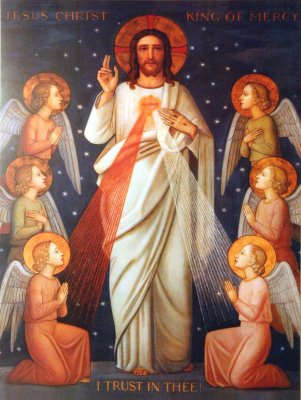
Jesus, I trust in you

The where and how of conversion

This morning finds us one day short of the First Sunday of Lent, which will begin this holy season in earnest. Last night I read a post over on Cahiers Péguy by my friend Sharon that struck me as being what Lent is all about. Lent is not about doing things we don't do the rest of the year, including not eating meat on Fridays and, ideally, even fasting. On my view, it is about doing these things more intensively and conscientiously, which means striving to live more in the awareness of destiny. This brings up, yet again, the reality that the disciplines we intensify during this holy season are means to an end, namely starting from image and moving to likeness, a movement only made possible in Christ, with Christ, and through Christ, by the power of the Holy Spirit.

Sharon's post, A vocation to the real, takes this up in a very concrete way. She points out that the where and the how of Christ at work seeking to make you over into His likeness is staring you in the face at every moment.

On this interstitial Saturday in Lent I want to turn back to my fellow deacon, the Syriac, St. Ephrem, who brings up the need we have to die to ourselves, giving it the gravity it deserves by putting it in the context of destiny:

"On that dreadful and amazing day, You shall say to us sinners, O Lord: ‘You men know well what I have undergone for you; what have you suffered for Me?’…The martyrs will point to their wounds, their sufferings, the severed parts of their bodies… The ascetics will point to their asceticism, to their long fasts and vigils, to their liberality…But I, idle, sinful, transgressing as I am, what shall I be able to point to? Spare me, O merciful One! Spare me, O Thou Lover of mankind!"

I am always dismayed at the amount of what I can only call silliness that spills forth on and around Ash Wednesday concerning Lent, thus trivializing what is a solemn and holy season. As one who sees the benefit and even the need to be interconnected, I suppose much of this has its place, given the tremendous pastoral need. So, I can deal with those efforts that don't consciously strive to be merely entertaining. Efforts aimed at entertaining, as well-intentioned as they may be, only serve to add more clutter to a culture increasingly made up of distractions.

Starting this Monday I will be posting less, at least over the remainder of Lent. I will definitely continue our Friday traditio and I will put something up on the Sunday readings. I take a kind of odd pride in posting something everyday. So, I will be working on that over Lent. One feature that I am discontinuing altogether is the U.S. hierarchy updates. The best resource for keeping up on these events is the Catholic-Hierarchy News blog, which I feature in my blogfeed over on the right.

I have never judged the success of this endeavor by any quantitative method. Suffice it to say, I do not see myself as an entertainer, but as a deacon who hopes he is providing a service. One service I hope I provide is a blog that has some continuity and coherence from post-to-post, day-to-day, week-to-week, etc., even if I run the risk of being a little repetitive. After all, continuity requires overlap. It also bears mentioning that being serious does not mean being either joyless or humorless.

One cannot post during these days without continuing to ask for prayers for the people of Japan. This morning an explosion was reported at the Fukushima-Daiichi nuclear power plant that was damaged by the 8.9 earthquake. The explosion raises the concern that one of plant's reactors has started to meltdown. Lord, hear our prayer.

Meum cum sim pulvis et cinis

"Some say we're born into the grave"


Former Alice in Chains bassist Mike Starr died in Salt Lake City last Tuesday, 8 March 2011. Starr waged a difficult battle against drug addiction for many years. So, Them Bones off Alice in Chains' album Dirt is the first Friday traditio of this Lent.

Spencer Roddan, Starr's friend, with whom he was living in SLC at the time of his death, said that he preferred to remember his friend "as a fun-loving jokester who loved eating gyros at local fast-food chain 'Mad Greek.'"


Here's the part that gets me: "The night before he died, he said to Roddan, 'Spencer, I love you.'"

"He was messed up and I didn’t know what to do," said another of Mike's friends, referring to a conversation that same night, "I gave him a hug and said I loved him."

Dust rise right on over my time
Empty fossil of the new scene
I feel so alone, gonna end up a
Big hole pile a them bones


Last night I had dream about the last time I saw my Dad alive. It was exactly how I remembered it: I was looking at him and he was looking up at me. I kissed him on his forehead and, with tears, I said "Dad, I love you." He took my hand, held it tightly, and said "I love you so much." I told him I needed to leave, but that I didn't want to. He gently said "Go." I told him I was worried that wouldn't be there when I returned.

Memento mori, indeed!

In either case, love is stronger than death, which is what keeps death from turning us into a pile of them bones. In Psalm 51, which recite each Friday at the beginning of Morning Prayer, we say, "Make me hear rejoicing and gladness, that the bones you have crushed may revive. From my sins turn away your face and blot out all my guilt."

Of course, this morning we pray for those affected by the tsunami in northeastern Japan, caused by a 8.9 magnitude earthquake off the coast of that island country.

Jesus, I trust in you.

Meum cum sim pulvis et cinis

The work of Another

Pastoral ministry is not for the easily discouraged. I have been reflecting almost all day today about the investment-to-return ratio in ministry. It is not very great. In that way it bears a resemblance to blogging. Both require a lot of effort, at least if one tries to do them well, but do not immediately or even obviously bear a lot of fruit. Therefore, I am heartened that it is not about efficiency, which is not to say that I don't try to learn from my experiences and find ways of doing things better, I do.

The Martyrdom of St. Stephen, by Pieter Paul Rubens

Look at Jesus' own ministry, it was not efficient, at least not until after His resurrection and Ascension, and the descent of the Holy Spirit, when it multiplied exponentially. This is why, as we were exhorted in yesterday's Gospel, to put everything we do at the service of bringing about God's reign. It is a matter of trust; the work of Another. It is not my work. I have merely been called to help as a laborer in the Lord's vineyard. I am certainly under no illusion that I am the best, or even the most diligent worker in the vineyard, let alone the most gifted. I am grateful beyond measure to be called to the work I have been given and I pray that I am a good steward of those gifts I have received, as meager as they might be.

Judged by any worldy criteria, we might well determine pastoral ministry isn't worth the effort.

Where is Zion?

"It shall come to pass in the latter days that the mountain of the house of the Lord shall be established as the highest of the mountains, and shall be lifted up above the hills; and all the nations shall flow to it, and many peoples shall come, and say: 'Come, let us go up to the mountain of the Lord, to the house of the God of Jacob, that he may teach us his ways and that we may walk in his paths.' For out of Zion shall go the law, and the word of the Lord from Jerusalem" (Isa. 2:2-3).

Being a native Utahn and having grown up LDS, we were always taught that the above passage from Isaiah was an ancient prophecy referring to my home state in general and Salt Lake City in particular. Utahns refer to our state as Zion both jokingly, as in "Life behind the Zion curtain," and seriously. Of course, those who do so in a more serious vein see Utah as a kind of promised land, even if a provisional one. Why provisional, you may ask? Because the LDS faithful believe that the New Jerusalem will be established in Jackson County, Missouri, which they also believe to be the location of the biblical Garden of Eden.


Over the long history of its written use, going back over three millenia, Zion eventually came to refer to the Promised Land to come, where God dwells with His people. For Christians, Zion can be anywhere in the world because, as we were reminded at Mass yesterday in our reading from the letter in which St. Paul tells the Christians of ancient Corinth, "you are the temple of God" because "the Spirit of God dwells in you" (1 Cor. 3:16).

What brought these verses from Isaiah to mind this morning was that today's canticle for Morning Prayer, as it is every Monday when we pray the third week of the psalter, begins with this passage. On this glorious winter morning in the mountains of my Zion, I am reminded of a lovely hymn I grew up singing:

"O ye mountains high, where the clear blue sky
Arches over the vales of the free,
Where the pure breezes blow and the clear streamlets flow,
How I’ve longed to your bosom to flee!
O Zion! dear Zion! land of the free,
Now my own mountain home, unto thee I have come;
All my fond hopes are centered in thee."

The need for humanity in the so-called cyberworld

With last Sunday's near fatal crash of my blog, I have been reflecting all week on blogging. My reflection was intensified somewhat by the decision of a friend to discontinue blogging for wholly healthy and good reasons. From time-to-time I like to step back and evaluate my on-line endeavor, which I began tentatively back in August 2005 and took up in earnest in July 2006. Since then blogging has constituted part of my daily life. Yesterday I decided to "Google" Καθολικός διάκονος. Predictably, most of the returns were links back to this blog. More disturbingly and downright puzzling were several links to sites like sex-while-dating-child-support-parents.searchforsinglesmeetsingles.com and get-laid-without-being-broke-file-divorce.searchforsinglesmeetsingles.com. Huh? I can't think of another arena of endeavor in which one's brand, if you will, can be so easily high-jacked and associated in any way with purposes with which it is so at odds. Overlooking the fact that nothing could be more contrary to the tone and tenor of what I post here, such sites are a truly sad commentary about what many people look for on-line.


What people are looking for, whether they know it or not, is fulfillment, satisfaction, happiness. What makes it sad is that seeking hook-ups, looking at pornography, even playing W.O.W. for hours, or days, on end, will never result in any of the above. The nature of addiction, which results in wanting and needing more, more, and still more of whatever it is you are addicted to, even unto death, demonstrates this quite well. Nonetheless, I am happy to join with others who seek to be salt and light in the cyber realm, pointing people to what (more accurately, Who) can truly satisfy.

I have never had site meter on this blog, nor will I ever. Up until late last summer I truly had no idea how many people visited Καθολικός διάκονος on daily, weekly, or monthly basis. Well now, Blogger automatically applies Google Stats to all blogs and with a few mouse clicks I can pull up and look at not only how many people visit, but where they link here from, and what posts they look at. For those of you who are concerned about privacy, there is no individual information provided, all data is aggregated. The reason I mention this is because sometimes in the daily stats I will see a huge surge in visits to my blog from some weird source, like this one "local news update. Welcome to the digital jungle!

On a much more positive note, I found that my blog made the Our Sunday Visitor reader's choice The very best of the Catholic Web list. I was even more surprised that I had been submitted under the opinion category by a friend, who was a professor of mine, Susan Windley-Daoust, who wrote: "Good intellectual thoughtful op-ed on matters in the Church and spiritual life by a deacon in Salt Lake City." Dr. Windley-Daoust blogs under the name Ironic Catholic. I appreciate this endorsement very much and certainly hope those who visit Καθολικός διάκονος find all that and even more. Not just by way of a courtesy quid pro quo, I highly recommend adding the IC (as her blog is known by the cool kids in the Catholic blogosphere) to your favorites.

Having to reconstruct the design of my blog was an opportunity to freshen it up a little, while maintaining continuity with the past. One thing I did not change was my statement of purpose, which appears under the title. I really worked at shaping and honing this for a long time. Therefore, I truly mean that "This is a public cyberspace in which I seek to foster Christian discipleship in the late modern milieu in the diakonia of koinonia and in the recognition that 'the Eucharist is the only place of resistance to annihilation of the human subject.'" The quote at the end of the sentence is from Archbishop Francisco Javier Martinez.

The Internet and our ever more advanced means of communication bring many advantages to us, but also present many threats and pitfalls to our common humanity on a deeply existential, that is, relational level. The so-called cyberworld is just another aspect of the real world, albeit one that expands our notion of reality and alters, at least to some extent, our relationship to time and space. Over and above the concerns with which I began this post are other concerns about how all of this impacts us both individually and collectively. I have been struck of late by a series of commercials by Sprint Mobile that do a far better, not to mention more entertaining, job of highlighting these concerns than I could do by writing about them:

Failed technical experiments in blogging

Okay, today I got the bright idea to update my blog template because Καθολικός διάκονος has had the same look for a year now. Well, it was a failed experiment that ultimately forced me to delete my blog and start over again. Even though I back my blog up as a .xml file at least every month and usually more frequently, some elements were irretrievably lost, like my list of people who read my blog.


Every failure is an opportunity to start again. So, I urge all my long-time readers and any new readers to "Follow" Καθολικός διάκονος. I refer to it as my list of people who encourage me. I guess like Paul, I only urge people to follow me to the extent I follow Christ and I am very certain I am not nearly the disciple Paul was ( 1 Cor. 11:1). I invite you join me on this on-going journey of faith, hope, and love.

An early morning ramble

UPDATE: One drawback of writing an early morning ramble is typing incoherently. So, I have cleaned up this post in the hope of making it more readable.

I am very grateful that I do not suffer from very many sleepless nights. Last night was one, however. It's funny what I start to think about at 2:00 AM. Mainly I start to think about people I have met and gotten to know over the course of my life. As a result of thinking about people, I start to think about places, which makes me remember growing up in Ogden, Utah. Even when I was a teenager, even though I wanted to, I never felt I would go anywhere or do anything. So, it always amazes me to think about the places I've been and the things I have done. In kind of a circular sweep, I once again start thinking about some of the people I have met along the way.

Frankly, if I did not know so many wonderful people, I would be a misanthrope. This is how experience not only shapes, but sometimes overrides what I think. I guess I have been very blessed to meet and to get to know so many truly wonderful people. I admit that it is often the case that it takes time for me to like many of the people I meet. I realize that this flows from my own insecurity. In other words, it is easy and kind of natural for me to see others as a threat. A lot of this is the result of essentially being an introvert (being introverted is not synonymous with being shy).

I remember when I was in formation to become a deacon and during one of our third year sessions Deacon Owen Cummings said something like "We have to learn to see others as blessings and not as threats." This is a challenge for me on many fronts. One of those fronts is consciously trying to be a blessing to others and not, out of insecurity, try to be intimidating, which can be done in a number of ways. Trying to be physically imposing, or intellectually imposing, or even spiritually imposing.

At the end of my late-night musings, I can't help but think of Christ, not least because I start to worry, especially about others. I think of all the people I have been privileged to serve, even before my ordination. I think of the many people I have encountered through RCIA and think of those I have not seen in a long time. I wonder where they are, how they are doing, whether they are still attending Mass, going to confession, and otherwise living and growing in the faith, living in the awareness of their destiny, recognizing in Christ their origin and end. Thinking about these things becomes burdensome, which is why I start to pray for them; for those who seem have been laid upon my heart, whose faces I see clearly. I am reminded that the Lord is kind and merciful, that He is our Savior. I think of how much responsibility my bishop has, how much our vicar general, who is also our vicar for clergy, has, how much is entrusted to the rector of our Cathedral and I pray for them. I also thank God that I am called to help them and pray that I can be a good deacon, a good servant.


This morning I was led to a passage from the sixth chapter of St. John's Gospel, which is God's word for me today, a word of comfort and of joy:

"All that the Father gives me will come to me, and whoever comes to me I will never cast out. For I have come down from heaven, not to do my own will but the will of him who sent me. And this is the will of him who sent me, that I should lose nothing of all that he has given me, but raise it up on the last day. For this is the will of my Father, that everyone who looks on the Son and believes in him should have eternal life, and I will raise him up on the last day" (verses 37-40).

Jesus, I trust in you.

Give us this our daily bread

It's hard to believe that the first month of 2011 is over. So, today we began the month of February. One way to look at the way we mark time, whether by the Gregorian calendar or the liturgical calendar, is that we have many opportunities for new beginnings. I think the month of January for many people is often disastrous because of all the New Year's resolutions they heap on themselves. Maybe February is the month of recovery from our self-imposed tyranny. Appropriately, most years Lent begins in February, though not this year, due Easter arriving quite late (24 April).

Here in Utah February is very possibly the coldest, deadest month of the year, at least in terms of what goes on outside. For example, our high today will not top 20 degrees (Fahrenheit) and it will not snow. No sooner than I start being affected by all of this we'll have a sunny, relatively warm day, a day that reminds me Spring will come. Of course, the parallel to this obvious; it is a sign of something more than Spring. It is also a reminder that God gives us what we need, most often not in dramatic fashion, but in a quiet, steady way.

These thoughts put me mind of the episode in 1 Kings 17, in which Elijah goes to stay with the widow of Zarephath during a famine caused by a severe drought. When the prophet tells the widow, who barely has enough to feed herself and her son, to feed him, too, she protests, saying, "As the Lord your God lives, I have nothing baked, only a handful of flour in a jar and a little oil in a jug. And now I am gathering a couple of sticks that I may go in and prepare it for myself and my son, that we may eat it and die" (verse 12- ESV). Elijah responds: "Do not fear; go and do as you have said. But first make me a little cake of it and bring it to me, and afterward make something for yourself and your son. For thus says the Lord, the God of Israel, ‘The jar of flour shall not be spent, and the jug of oil shall not be empty, until the day that the Lord sends rain upon the earth'" (verses 13-14- ESV).


The widow did what Elijah told her to do and as a result "she and he and her household ate for many days. The jar of flour was not spent, neither did the jug of oil become empty" (verses 15-16- ESV). There are plenty of things to point to in this story, lessons, as it were, but for me today the obvious thing is that God is faithful to His promise. The woman did not wake up the next morning to find her larder filled to overflowing with oil and flour (what good would that do?), but everyday there was enough for her, her son (who soon died and was raised from the dead by Elijah), and for her guest, the prophet.

I suppose an alternate title of this post could've been "Bake Me a Cake as Fast as You Can", in which case it would need to be rolled, poked, and marked with an "E" and thrown in the oven for Elijah and me!